
CALL NOW: (314) 478-8877
Will An Oral Appliance Stop My Snoring?

TL;DR
- Oral appliances reduce or eliminate snoring in 85–90% of patients - the device physically holds your jaw forward so your airway can't collapse the way it does when you snore.
- Custom-fitted devices from a dental sleep medicine specialist outperform over-the-counter options significantly: 60% success rate vs. 31% for OTC mouthpieces.
- Compliance rates are nearly double that of CPAP - roughly 90% vs. 50% - which means more people actually use them, night after night.
- They work best for mild to moderate obstructive sleep apnea and primary snoring. Severe OSA, active TMJ disorder, or significant teeth-grinding may need a different approach.
- Most patients notice improvement within the first week. Full titration takes 6–8 weeks.
- Medicare and most medical insurance cover oral appliance therapy when sleep apnea is diagnosed.
If you've been told you snore - or you've woken yourself up doing it - you already know it's not just an annoyance. It disrupts your partner's sleep, fragments your own, and may signal something more serious happening with your airway while you sleep. The question most people reach for first is: is there something I can just put in my mouth that will fix this?
The short answer is yes. The longer answer is that it depends on what's causing the snoring, what kind of device you use, and whether you work with someone who knows how to fit it properly.
Why You Snore in the First Place
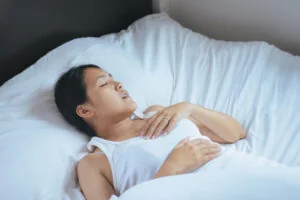
Snoring happens in your throat, not your nose. When you fall asleep, the muscles in your mouth and throat relax. If there isn't enough space for air to pass through cleanly, the soft tissue - your soft palate, uvula, and base of the tongue - vibrates against the airway walls as you breathe. That vibration is the sound.
The narrower the airway, the louder the snore. At the extreme end of that narrowing, the airway collapses completely. That's obstructive sleep apnea: repeated pauses in breathing throughout the night, each one lasting 10 seconds or longer, each one causing a partial awakening your brain doesn't fully register.
The structural cause is what makes oral appliances work. If you can hold the jaw slightly forward, the tongue moves with it, the airway opens, and the tissue that was vibrating has room to sit still.
How a Mandibular Advancement Device Actually Works
The most common type of oral appliance is a mandibular advancement device (MAD) - a custom-fitted mouthpiece that positions your lower jaw a few millimeters forward of its resting position while you sleep.
Diagram showing how a mandibular advancement device (MAD) opens the airway: without the device (left), the tongue falls back and the airway narrows; with the MAD (right), the jaw is held forward and the airway stays open.
That forward positioning does two things:
- It pulls the base of the tongue away from the back of the throat.
- It tightens the soft tissue around the upper airway so there's less loose material to vibrate.
A second device type - the tongue-retaining device (TRD) - works by holding the tongue forward directly, using gentle suction. TRDs are less common but useful for patients who can't advance the jaw (those with significant TMJ issues, for example).
Both device types are designed and titrated by dental sleep medicine specialists, not by a one-size-fits-all mold from a pharmacy shelf.
What the Numbers Actually Say
Oral appliance therapy is one of the most studied non-surgical snoring and sleep apnea treatments. Here's where the research lands:
- 70% of MAD users see more than a 50% reduction in AHI (apnea-hypopnea index, the standard measure of sleep-disordered breathing) - a threshold considered clinically meaningful.
- 85–90% of patients report significant reduction or elimination of snoring with a custom-fitted device.
- A 2024 study in the Journal of the American College of Cardiology found MADs are non-inferior to CPAP for blood pressure outcomes in mild to moderate OSA - a finding that matters because untreated sleep apnea raises cardiovascular risk.
- The American Academy of Sleep Medicine recommends oral appliances as first-line therapy for mild to moderate OSA, and as an alternative for severe OSA in patients who cannot tolerate CPAP.
These numbers represent custom-fitted devices. Over-the-counter boil-and-bite mouthguards show considerably weaker results - about 31% success rate compared to 60% for custom appliances - and can cause jaw pain or worsen symptoms if the advancement isn't calibrated correctly
.
Oral Appliance vs. CPAP: Which Is Better for Snoring?
Comparison chart: Oral Appliance vs. CPAP - snoring reduction, 90% vs 50% compliance, travel portability, noise level, and best use case
CPAP - continuous positive airway pressure - is the gold standard for severe obstructive sleep apnea. It works by pushing pressurized air through a mask to physically prop the airway open. It's highly effective when used correctly.
The problem is "when used correctly." Studies consistently show CPAP compliance rates around 50% - meaning half of prescribed patients aren't using it as directed, or have abandoned it entirely. Mask leaks, machine noise, claustrophobia, and travel inconvenience are the most cited reasons.
Oral appliance compliance sits around 90% for patients who are good candidates. A small, silent device that goes in like a retainer and comes out in the morning has a much lower friction cost than a mask connected to a bedside machine.
For mild to moderate OSA and primary snoring, the evidence supports oral appliances as at least as effective in practice - because people actually wear them. For severe OSA, CPAP remains the stronger first-line option, though some patients use a combination of both.
The bottom line: CPAP might perform better on paper; oral appliances perform better in real bedrooms.
Who Gets the Best Results
Not everyone is a strong candidate, and an honest specialist will tell you that upfront.
Infographic: Who gets the best results - good candidates on the left (mild to moderate sleep apnea, CPAP intolerant, snoring without severe OSA, healthy teeth and gums) and less suitable on the right (severe sleep apnea, central sleep apnea, active TMJ, missing teeth, chronic teeth grinding)
Generally good candidates:
- Mild to moderate obstructive sleep apnea (AHI 5–30)
- Primary snoring without significant OSA
- Patients who cannot tolerate CPAP
- Adults with healthy teeth and adequate jaw range of motion
- People in the 45–60 age range who are starting to notice airway changes with weight or anatomy
Less suitable:
- Severe OSA (AHI > 30) - oral appliances may still help but should be combined with or compared to CPAP
- Central sleep apnea (the problem is in the brain's signaling, not the airway mechanics)
- Active TMJ disorder or significant jaw pain
- Extensive tooth loss or poorly fitting dentures
- Moderate to severe bruxism (teeth grinding) - though some devices are designed to accommodate this
A sleep study is essential before starting oral appliance therapy. It's the only way to determine whether OSA is present, how severe it is, and which treatment is appropriate. Some patients go in thinking they have a snoring problem and come out with a diagnosis that changes how they manage their health.
What to Expect During Treatment
The first step is a consultation with a dental sleep medicine specialist - not a general dentist, and not a sleep physician alone. Dental sleep medicine sits at the intersection: the specialist interprets your sleep study, takes precise dental impressions, and designs a device specific to your anatomy.

The typical timeline:
- Sleep study (in-lab or at-home) to confirm diagnosis and severity.
- Dental exam to assess suitability - teeth, gums, jaw joint.
- Impressions and device fabrication - takes 2–4 weeks for a custom device.
- Fitting appointment - the device is placed, adjusted, and initial settings calibrated.
- Titration over 6–8 weeks - the jaw position is gradually advanced until snoring stops and breathing normalizes.
- Follow-up sleep test - to confirm the device is working as intended and OSA is controlled.
What most patients experience in the first week: mild jaw soreness or stiffness in the morning, which resolves as muscles adapt. Some temporary changes in bite alignment that normalize after the device is removed each morning. These are expected - not warning signs.
Satisfaction rates in patient communities hover around 75%, with most complaints centering on the adjustment period rather than long-term use.
The Custom vs. OTC Question
Pharmacy mouthguards and boil-and-bite devices are marketed aggressively for snoring. Some people try three or four of them before landing in a specialist's office.
The difference isn't just fit. It's calibration.
A custom device is titrated - the amount of jaw advancement is adjusted incrementally based on your response. Too little advancement and the airway isn't sufficiently opened. Too much and you strain the jaw joint. The sweet spot is individual, and getting there requires professional follow-up.
OTC devices can't be titrated. They hold the jaw at a fixed position - usually a moderate advancement - that may or may not match what your airway needs. The 31% vs. 60% success rate gap in the research reflects this.
A custom device also costs more upfront ($1,500–$3,600 depending on device type and region), but Medicare covers oral appliance therapy for OSA, and most medical insurance plans do as well. If you have a diagnosis, the out-of-pocket cost is typically a fraction of the device cost.
The EMA Device: One Example Worth Knowing
The Elastic Mandibular Advancement (EMA) device is one of the thinner, lower-profile options used in dental sleep medicine. It uses interchangeable elastic straps to control jaw advancement - which means different amounts of advancement on different nights if needed, and a design that allows more lateral movement than fixed-hinge devices.
EMA oral appliance - a thin custom-fitted mandibular advancement device.
It's not the right device for everyone - no single device is - but it illustrates the range of options available beyond the basic boil-and-bite concept. A board-certified dental sleep medicine specialist will match the device to your anatomy, bite, and clinical needs rather than defaulting to one model.
Dr. Gotsis - Midwest Dental Sleep Medicine Institute
If you're in the St. Louis area and are ready to move beyond guesswork, Dr. Tom Gotsis at the Midwest Dental Sleep Medicine Institute in Bridgeton, MO is one of a small number of specialists in the region who is board-certified by both the American Academy of Dental Sleep Medicine (AADSM) and the American Sleep and Breathing Academy (ASBA).
That dual board certification matters. It means Dr. Gotsis has met the highest clinical and educational standards in the specialty - not just a general dentist who offers sleep appliances as an add-on service. He also teaches at SIU School of Dental Medicine, which means his practice reflects current evidence, not dated protocols.
His practice focuses exclusively on dental sleep medicine: oral appliance therapy for snoring and OSA, CPAP alternatives, and working in coordination with sleep physicians to manage the full picture of your sleep health.
Visit the Midwest Dental Sleep Medicine Institute - Dr. Thomas Gotsis, Board-Certified Dental Sleep Medicine Specialist in Bridgeton, MO
A consultation starts with your sleep study results and a comprehensive dental exam. From there, Dr. Gotsis will determine whether you're a candidate, which device fits your situation, and how to navigate insurance coverage.
Schedule a consultation
Frequently Asked Questions
How effective are oral appliances at stopping snoring? Clinical studies show oral appliances reduce snoring in 85–90% of patients. Custom-fitted mandibular advancement devices eliminate or significantly reduce snoring in most cases, with roughly 70% of users seeing more than a 50% reduction in apnea-hypopnea index - the standard measure of sleep-disordered breathing severity.
Is an oral appliance better than CPAP for snoring? For mild to moderate sleep apnea and primary snoring, oral appliances are often preferred because compliance rates are dramatically higher - around 90% for oral appliances versus 50% for CPAP. CPAP is more effective at the most severe end of the spectrum, but a treatment you actually wear every night beats one that sits on the nightstand.
How long does it take for an oral appliance to work? Many patients notice snoring improvement within the first few nights, though full therapeutic benefit typically takes 6–8 weeks as the device is titrated to the right jaw position. The adjustment period involves some jaw soreness in the first week, which usually resolves on its own.
Can an oral appliance help if I have sleep apnea, not just snoring? Yes - oral appliances are FDA-cleared and covered by Medicare for obstructive sleep apnea. They're most effective for mild to moderate OSA. Patients with severe OSA may still benefit, particularly if they can't tolerate CPAP, though CPAP remains the gold standard for severe cases.
Does insurance cover oral appliances for snoring? If snoring is accompanied by a diagnosed sleep disorder like OSA, most medical insurance plans - including Medicare - cover oral appliance therapy. Coverage for primary snoring alone varies by plan. A dental sleep medicine specialist can help navigate the prior authorization process.
Sources: American Academy of Dental Sleep Medicine (AADSM); Sleep Foundation; Mayo Clinic; Cleveland Clinic; Journal of the American College of Cardiology (2024); National Center for Biotechnology Information / PubMed.